Cartos · Phase III — Defined

Cartos Field.

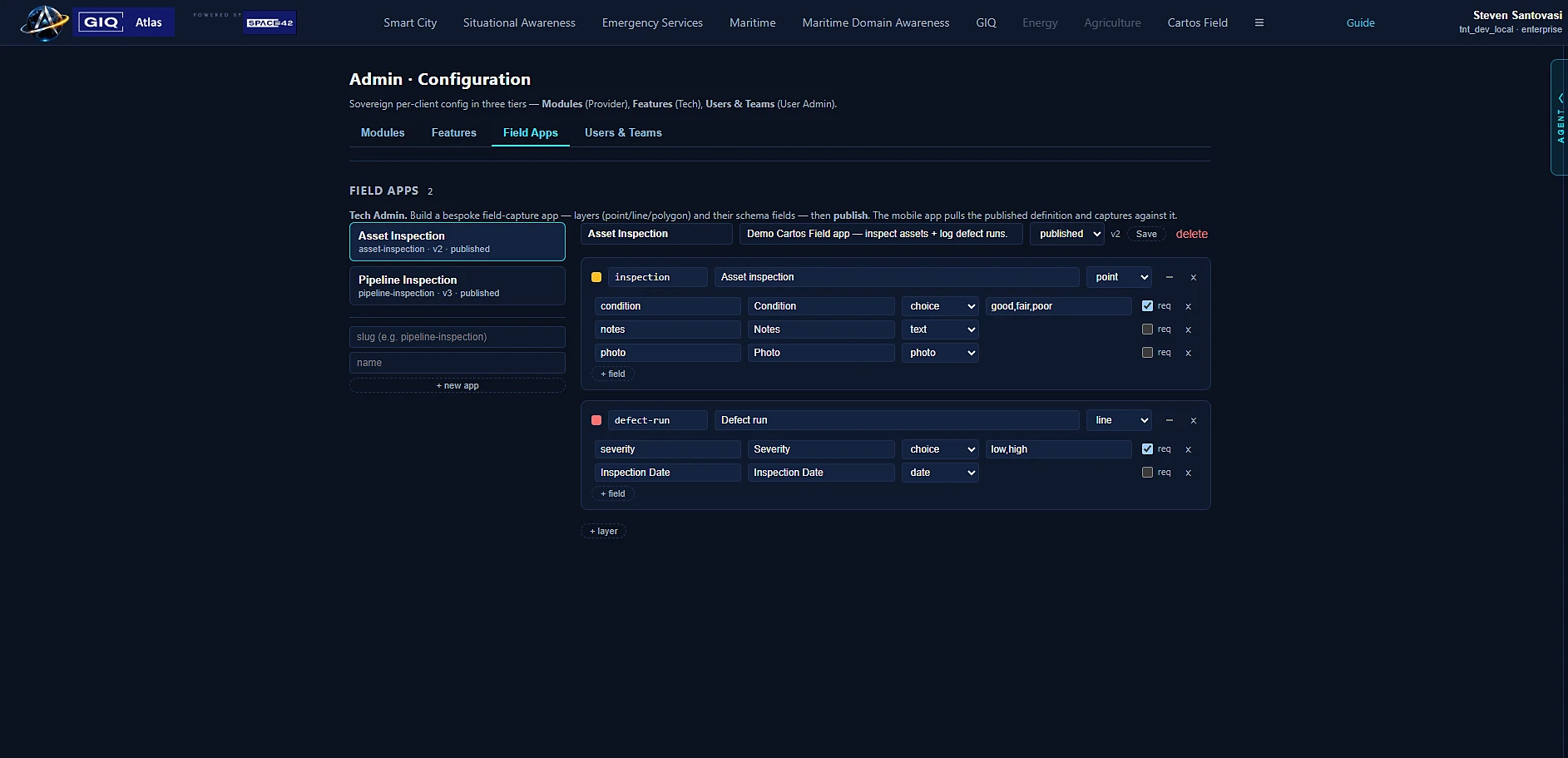
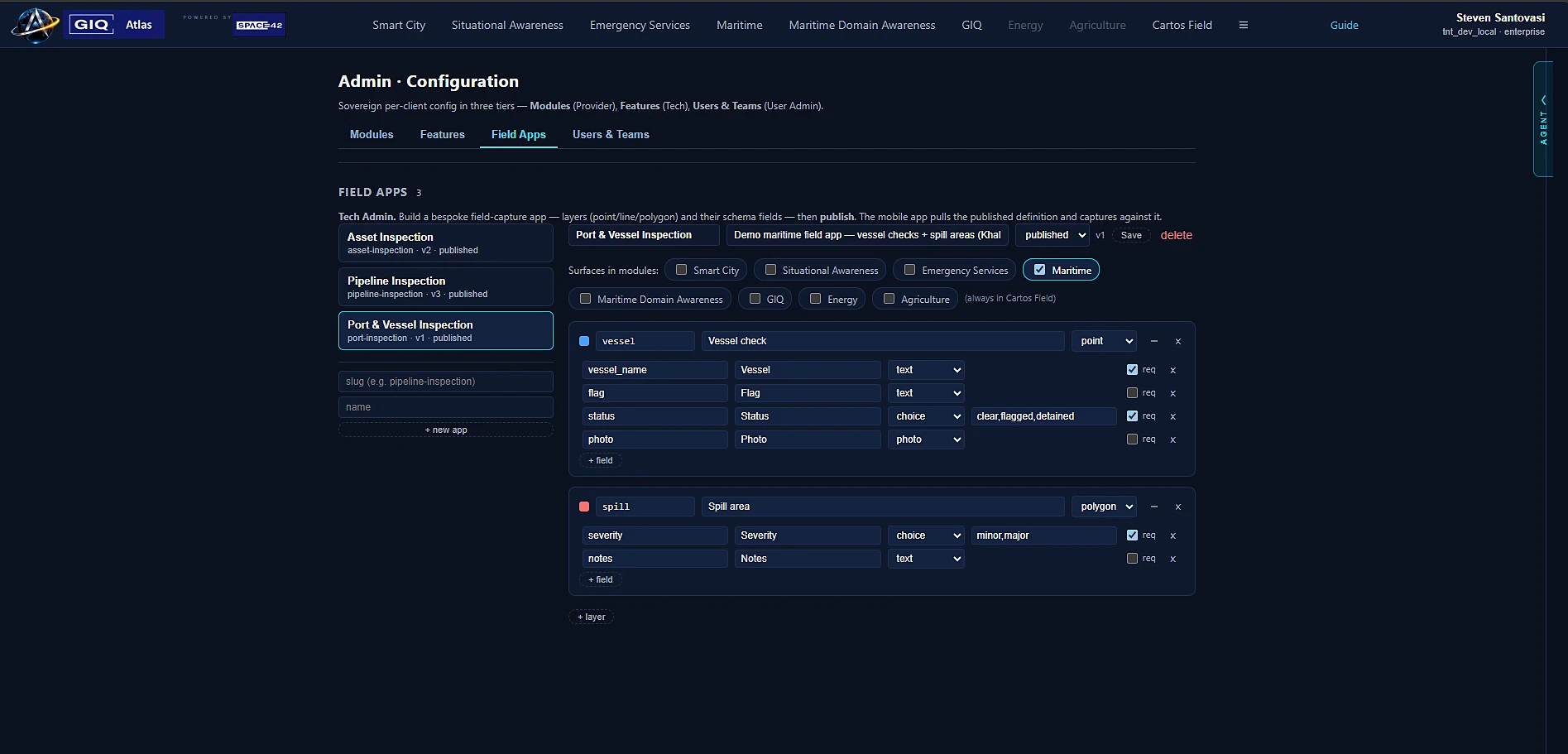
Not one app — a platform for standing up bespoke field apps from common pieces. Admins define layers, schemas, and forms in a web console; field workers run them in a native app that works offline and syncs into the Cartos data fabric. The sovereign ground-truth edge of the platform.

The thesis

A seat multiplier and a market expander.

Phases I–II serve the analyst — someone at a desk reasoning over imagery. But the picture is only as good as the ground truth feeding it. Today that ground truth is collected in disconnected tools that don't feed a sovereign AI platform, don't close the loop back to change detection or 3D, and aren't sovereign.

Phase I–II sells analyst seats — tens to low-hundreds per organisation. Phase III sells field seats — hundreds to thousands — plus entry into two large, fast-growing adjacent markets: field data collection and reality capture.

10×
Field seats vs. analyst seats per account
~3×
Relevant TAM vs. analytics-only sizing
~31%
LiDAR market CAGR, 2025–2030
0
Data-loss incidents — the offline bar

Product decision

Native field runtime + web config console.

The web can't reach LiDAR/ARKit, ARCore depth, or robust iOS background sync — so the field app is cross-platform native, while the admin/app-builder console is web.

OptionVerdictWhy
HTML5 / PWA as field appCompanion onlyNo access to Apple LiDAR/ARKit or ARCore depth from web; weaker offline + background sync on iOS. Ideal for a light viewer and the admin console.
Fully native (Swift + Kotlin)Overkill for v1Best device access, but two codebases double the cost — not justified until scale demands it.
Cross-platform native (Flutter / RN)RecommendedOne codebase across iOS + Android, near-native offline & performance, mature map/storage plugins; native modules added for LiDAR, GNSS/RTK.

Architecture fit

The ground-truth edge of the loop.

Captured features land in the data fabric as lineage-tracked observed datasets — joining the same derived-data graph, change detection, and 3D pipeline the analysts already use.

Web Config ConsoleLAYERS · SCHEMAS · FORMS Native Field AppOFFLINE · GPS · LiDAR Sync ServiceSTORE & FORWARD Data FabricOBSERVED DATASETS DEPLOY SYNC LINEAGE Phase II — derived-data graph · change detection · 3D reconstruction · reportingFIELD GROUND TRUTH MAKES THE AI BETTER — AND COMES BACK AS INTELLIGENCE
Figure 4. Config console → native field app → sync → data fabric, feeding (and fed by) the Phase II intelligence loop.

Release scope

Capture & sync first. Reality capture next. 4D last.

Offline capture with deferred sync is the normal case for field work, so it's v1 — the app fails its core job otherwise. Advanced offline and reality capture follow.

v1.0

Capture & Sync

  • Web app-builder: layers, feature types, schemas, forms with validation
  • Map viewport, locate & navigate to features
  • Create/edit points, lines, polygons & attributes
  • Geotagged photos on features
  • Offline capture + store-and-forward sync
  • Auth, tenant isolation, role-based edit
  • Captures land as lineage-tracked observed data
v2.0

Offline-first & Reality Capture

  • True offline-first: basemap/tile packs, large areas
  • Bidirectional sync with conflict resolution
  • High-accuracy GNSS / RTK over Bluetooth + NTRIP
  • 3D LiDAR / reality capture: device & pocket scanners
  • Point clouds, meshes, or splats
  • Video/audio media; richer form types
v3.0

4D & the loop closed

  • 4D capture: time-stamped reality over a site
  • Feeds 3D reconstruction & change detection
  • Active-learning loop: field observations label & improve the models
  • On-device agent assist in the field

Market sizing

Into faster-growing adjacent markets.

Market anchors from public 2025–26 industry reports. Treat the TAM/SAM/SOM model as illustrative and assumption-driven, not a forecast.

$0$5B$10B$15B Mobile GIS+38% ADOPTION · 2026 $2.5B Reality capture3D SCANNING · BY 2030 $16.66B LiDAR~31% CAGR · BY 2030 $12.79B GIS softwareTOTAL CATEGORY · 2026 $12.35B
Figure 5. Market anchors, USD. Reality capture and LiDAR grow far faster than core GIS — the markets Phase III opens. Sources: public 2025–26 industry reports.
$0$5B$10B 202520262027202820292030 $3.27B$12.79B
Figure 6. LiDAR market, $3.27B (2025) → $12.79B (2030), ~31% CAGR. Source: MarketsandMarkets, 2025.

TAM / SAM / SOM (illustrative)

TAM~$8–10BGlobal field-geospatial + reality-capture software (2026), growing ~15–20% blended.
SAM~$1.2–1.8BSovereignty-sensitive & Cartos-vertical buyers — gov/defence, utilities, critical infra, construction, environment.
SOM~$40–90MRealistic 3-year run-rate given Space42's position, UAE anchor, and a field-first pilot motion.

Competitive landscape

The field is crowded — and uniformly missing one thing.

Every serious tool does offline capture, forms, geometry, and photos. None is sovereign, inside an integrated GeoAI + owned-imagery platform, closing the loop from field to AI. That intersection is the entire opening.

CapabilityEsri suiteFulcrumQField / MerginTrimbleCartos Field
Offline capture & sync
Configurable bespoke apps✓✓partial
High-accuracy GNSS / RTK✓✓v2
Sovereign / in-territoryself-host✓ core
Integrated GeoAI + owned imagery
Field → AI loop (change / 3D / graph)
In-field 3D / 4D reality capturepartialpartialv2/v3
Auditable lineage to analyticspartialpartial
Market presence / maturity✓✓early
“Everyone else sells a field tool. Cartos Field is the sovereign ground-truth edge of an AI geospatial platform — for buyers who can't put their field data in someone else's cloud and want it to come back as intelligence.”

Go-to-market

Target segments & success metrics.

#Priority segmentWhy it fits
1Utilities & critical infrastructureInspection, asset capture, outage/change verification — high seat counts, sovereignty-sensitive.
2Government & defenceField ISR, asset/border survey, digital-twin programs — sovereignty is a hard requirement.
3Construction & siteProgress capture, as-built, 3D from the field.
4Environment & complianceMonitoring, sampling, geotagged evidence.
5TelecomFTTx and tower/site survey.
Success metricTarget signal
Field seats per accountOrder-of-magnitude above analyst seats
Offline reliabilityZero data-loss incidents in pilots
Time-to-stand-up a bespoke appHours in the console, not a dev cycle
Field data → derived graph% of captures reused by analysts / models
Survey-grade attach rateAccounts adding external GNSS / RTK

Design partner program

Put a sovereign field app in your workers' hands.

Utilities, gov/defence, construction, environment, telecom — if your field data can't live in someone else's cloud, let's talk. Engagements run under NDA.